Mot Section 4 Lighting Precheck Driveway Uk
If your MOT is close, the useful first move is not a full strip-down; it is a calm driveway check of every lamp, visible wiring run and warning lamp you can safely see. GOV.UK's MOT Section 4 manual is the public backbone here: it covers lamps, reflectors, electrical equipment, trailer sockets, visible wiring and the battery area.
What to check first
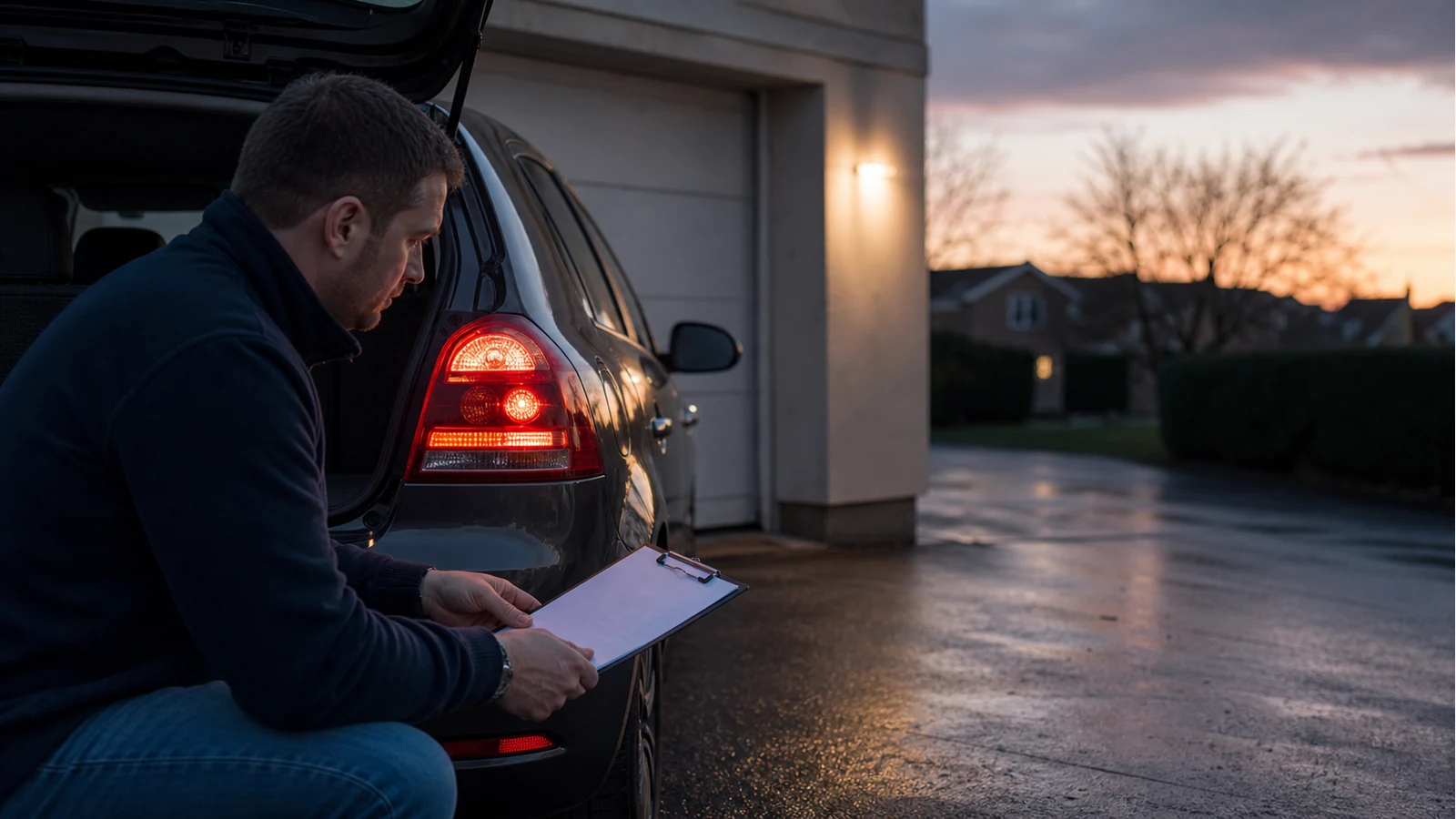
Start with the lights that are easiest to miss from the driver's seat. Ask a helper to stand behind the car, or reverse towards a garage door at dusk so you can see the reflections. A recent UK garage guide from F1 Autocentres on MOT light checks also points drivers towards simple walk-round checks before the booking.
- Stop lamps: press the brake pedal and confirm both sides and any high-level lamp behave normally.
- Position and tail lamps: switch them on with the ignition in the normal position for your vehicle and walk all four corners.
- Indicators and hazards: check the front, side repeaters and rear lamps; a fast tick often points to a fault on that side.
- Number-plate lamp: check it in the dark or shade, because it is easy to overlook in daylight.
- Fog and reverse lamps where fitted: use the handbook if the switch logic is not obvious.
- Tell-tales: warning lamps should behave as the vehicle handbook says, not stay lit with a fault.
When it stops being a bulb job
If one lamp is dead, use the cheap checks first: the correct bulb, the holder, the fuse listed for that circuit, and any obvious corrosion at the connector. If the bulb and fuse are sound but the lamp still will not work, treat it as a circuit problem rather than repeatedly swapping parts. Boot-lid looms, tow sockets, damp connectors and previous accessory wiring are common places to inspect before pulling trim apart.
Do not DIY these circuits
Stop before touching high-voltage hybrid or EV equipment, airbag/SRS wiring, ABS modules, melted insulation, smoke damage or any job that requires coding. A driveway check should help you decide what is wrong enough to book properly, not encourage risky repairs.
Next step if the simple checks pass
If a lamp circuit is still dead after the bulb, fuse, holder and visible earth checks, a low-voltage tracing workflow can help locate the break before trim removal. The product detail page for the Power Probe circuit tracer is relevant only at that point: when you already need to find where an open or short is hiding in a 12V loom.